


What is USALI?
USALI stands for “Uniform System of Accounts for the Lodging Industry.” It is the standardized financial reporting framework for hotels and is maintained by the HFTP and AHLA Global Finance Committee. It was first published 100 years ago, back in 1926.
Why Does it Matter?
USALI sets a standard for all of hotel finance. It is the reason a comptroller in Arizona and one in a different country, such as the UAE, could read each other’s P&L and understand them. There are three main reasons why this matters:
1. Benchmarking
Having uniform categories lets hotel managers compare properties across their portfolios, competitors, and the market writ large. This only works, however, if hotels classify their expenses the same way, which is exactly what USALI enforces.
2. Owner and Lender Support
Owners, asset managers, and lenders read dozens of properties’ financials. A consistent format lets these individuals evaluate property performance without having to decipher each hotel’s chart of accounts, and it makes covenant compliance and valuation easier to defend.
3. Management and Franchise Agreements
USALI is often written directly into management and franchise agreements, so falling short of its standards can end up being a contractual problem.
How is USALI Structured?
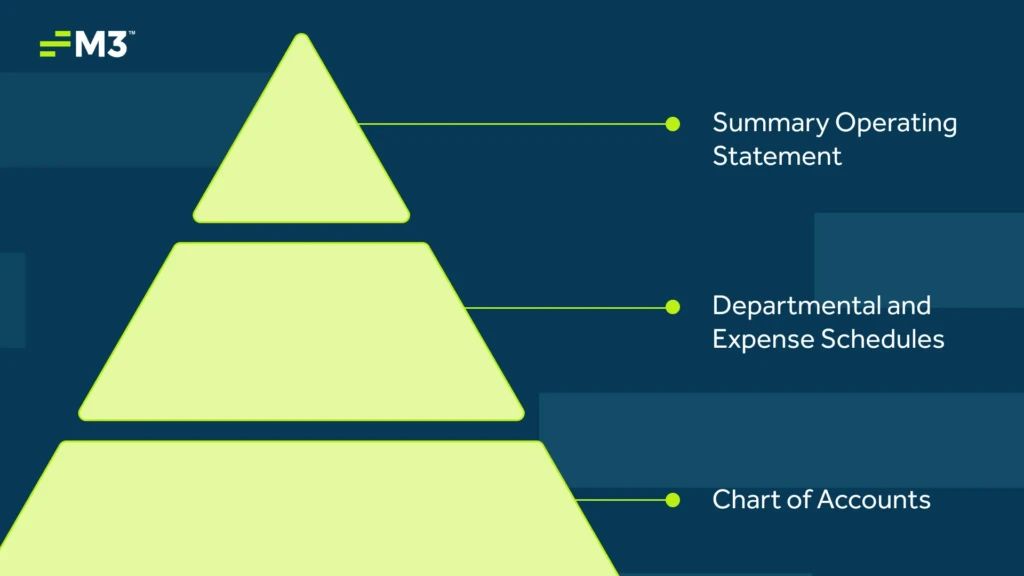
USALI has three layers: a summary statement at the top, departmental and expense schedules underneath, and, finally, a USALI chart of accounts.
The summary operating statement is a one-page view meant to be read first and covers topics like departmental revenue and expenses, undistributed operating expenses, and gross operating profit in a certain order. Each line in the summary statement is supported by its own schedule.
The departmental and expense schedules provide a framework for organizing and reporting revenues and costs for individual operating units and support services within a hotel property. The chart of accounts is the account-level foundation of USALI 12.
Each general ledger account has a standard structure that maps to a specific line on a specific schedule, and when transactions post to the right accounts, the schedules and summary statements build themselves. But when the chart doesn’t map clearly, finance teams end up having to rebuild statements by hand using spreadsheets.
What Changed in the USALI 12th Edition?
The 12th Revised Edition of USALI is the first major update to the rules since 2014. Published in July 2024 and adopted on January 1, 2026, the themes of this update are transparency, comparable data, and decision support. Here’s a quick overview of some of the larger changes:
- Executive lounges: A new schedule (Schedule 1-1) in the Rooms Department captures the costs of executive lounges
- Labor data: A new schedule (Schedule 15) reports full-time equivalent employees by department, enabling ratios like FTEs per occupied room.
- Brand and operator costs: A new schedule (Schedule 16) gives owners visibility into charges from brands and operators.
- Sustainability: Schedule 9 covers energy, water, and waste reporting. It used to be called “utility.”
- All-inclusive hotels: This category has a new Part II dedicated to revenue and expense reporting for all-inclusive properties, which have distinct pricing and operating models.
- Digital marketing categories: Three new expense categories were added: paid search, display, and social.
USALI Compliance in Practice
The USALI 12 effective date passed on January 1, 2026, but hotels still struggle with reporting under the new guidelines. Some of the tricky spots with these new guidelines are things like chart of accounts gaps, with legacy charts predating new lines. Data outside the GL can cause issues as well, as FTE and energy schedules need inputs from payroll systems and utility data, but if your payroll provider doesn’t record hours by department, you can’t build a Schedule 15. Contract alignment is also tricky, as agreements need to be up to date with how you report as well as the USALI 12 guidelines.
M3 Native USALI Alignment
M3 builds USALI compliance into the foundation of its software, offering:
- No Manual Rebuilds – M3’s Accounting Core is organized based on USALI 12, so departmental and undistributed reporting roll up without manual rebuilds
- No Catch-Up for New Customers – Al new M3 customers begin with a USALI 12-aligned financial structure.
- Resources for Existing Customers – M3 always provides guidance on updating financial reports and renaming or updating chart of accounts to reflect USALI 12.
These native features help smooth the transition to these updated guidelines, avoiding mistakes and adding efficiency to what can be a very tedious process.
Adoption of USALI 12 was mandatory starting January 1, 2026. Are your financial statements compliant, or do you need help with USALI accounting? Reach out to us here at M3 for a free consultation.
FAQs
Is USALI mandatory for hotels?
Yes, USALI is mandatory for hotels.
How does USALI affect a hotel’s chart of accounts?
USALI affects a hotel’s chart of accounts by providing a standard of consistent statement structure and departmental logic to which hotels have to map their own ledger accounts.


